Skip to content
Guide 023–4 min read

When is a scoliosis operation genuinely justified?

A surgical decision is rarely made spontaneously and never on the basis of a Cobb angle alone. This page explains which criteria must come together and why composure and a second opinion are time well invested.

What has to come together

Cobb angle, progression rate over the last 6–12 months, remaining growth (Risser, Sanders, menarche), trunk profile and appearance burden, breathing and cardiac function with very large angles, pain profile, and the social and school situation. The decision is always made in the medical conversation with the family and the adolescent, not by a number.

Why waiting and observing is often right

In growing children, a consistently worn brace can prevent or delay progression — and thereby make surgery unnecessary. An operation is final; a brace therapy is reversible. That is why treatment begins conservatively.

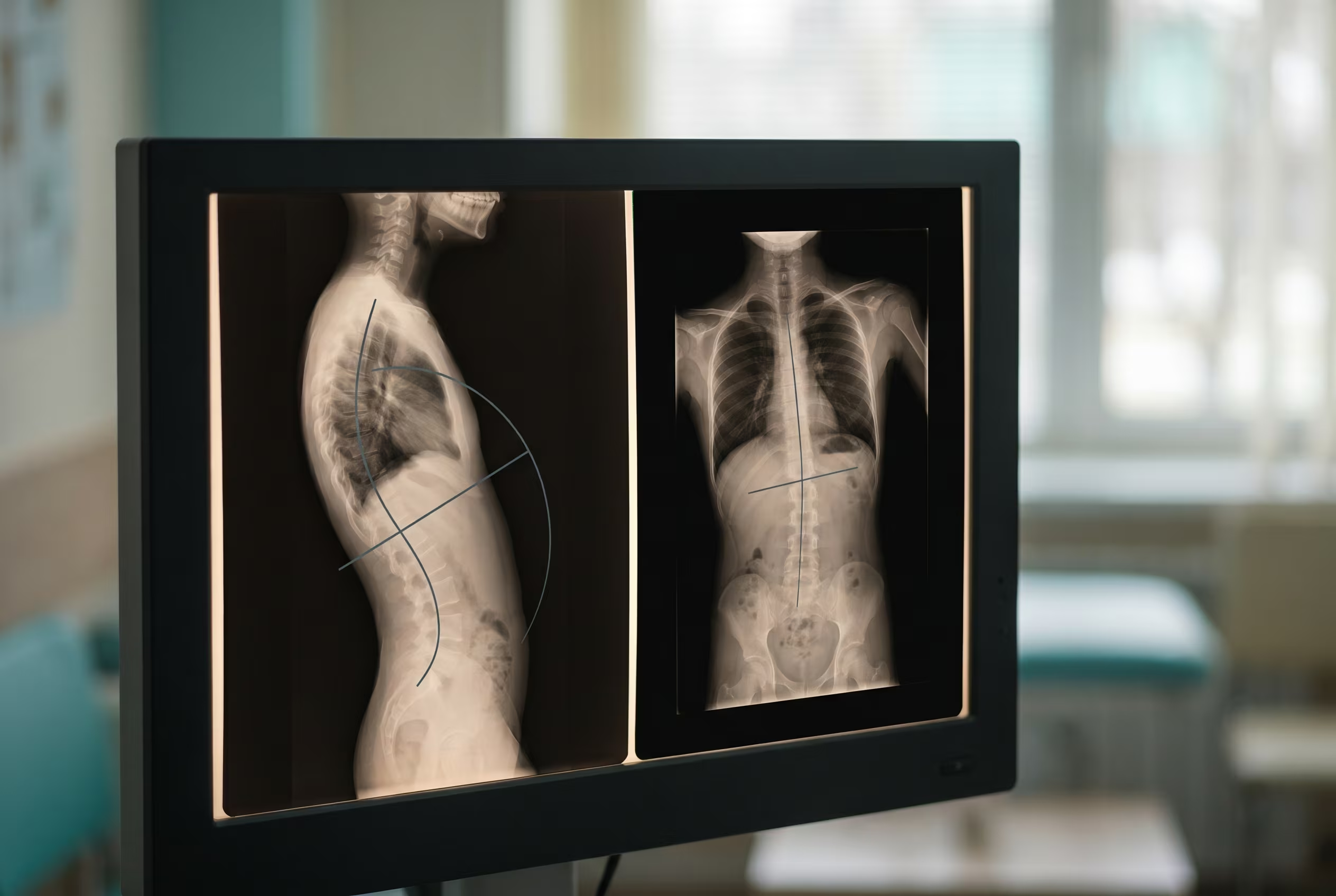
Before and after — how surgery restores spinal balance

Why not wait forever — the right moment

At values well above 50° thoracic, operations become technically more demanding and accompanying complaints more frequent. A good moment is often around the end of growth and before the angle makes operability unnecessarily harder.

Important to know

Two procedures, clearly separated

Spondylodesis (fusion with a screw-and-rod system): gold standard, very good stability and correction, fuses a section of the spine. Vertebral Body Tethering (VBT, motion-preserving): a special indication, mainly for certain thoracic curves with relevant remaining growth. Evidence is increasingly documented but not suitable for every curve. A second opinion is especially sensible here.

Chances and risks — honestly

Benefits: stable straightening, improved appearance, often clearly reduced progression, better breathing and lung situation with large curves. Risks: infection, bleeding, neurological complications (very rare), adjacent-segment problems, implant-related issues. Every operation is discussed individually.

The structured decision path

Clarification of facts (angle, course, growth), informed-consent conversation, written benefit-risk weighing, reflection phase, second opinion, shared decision. We explicitly recommend having more than one conversation before surgery is performed.

Important to know

A second opinion is welcome

We actively support seeking a second opinion and hand over the documents for it. A second opinion does not mean mistrust — it means quality.

For teens: directly to you

If surgery is being mentioned, it almost never happens next week. Nobody operates on a single Cobb number — the doctor looks at how the curve has behaved over time, how much growth you have left, how your back actually feels, and what bothers you in daily life. Between 40° and 50° thoracic there is real room for discussion. Above 50°, surgery usually makes sense, but "usually" still means your situation gets weighed. A second opinion is a normal part of this — ask for it out loud, bring your images, and take your time. You are allowed to want more than one conversation before deciding. Whatever path you end up on, it should be one you understand.

Your Checklist for This Topic

No surgery for mild stable curves. The 40–50° range is a gray zone requiring individualized assessment. Above 50° thoracic, surgery is typically recommended. Spinal fusion is the gold standard. VBT is for selected cases only, not a standard. Bracing can prevent progression to the surgical range.

If your child's curve is in the 40–50° range, it does not mean surgery is inevitable. It means you need an experienced specialist who looks at the full picture: growth stage, curve behavior over time, prior treatment response, and your child's symptoms. A second opinion is always reasonable at this point.

  1. Is my child's curve in the observation, bracing, or surgical range?
  2. What would happen if we wait 6 more months?
  3. Has the curve been progressing, and by how much?
  4. Would you recommend a second opinion?
  5. What are the specific risks of surgery for my child's curve type?

Request a second opinion at our center — we review your child's imaging and provide an independent, evidence-based assessment.

Book via WhatsApp

Related Guides

Sources & clinical guidelines
  • AWMF-S2kGerman AWMF-S2k Clinical Guideline "Adolescent Idiopathic Scoliosis" (registration no. 151/002), dated 15 March 2023, valid through 14 March 2028. register.awmf.org/de/leitlinien/detail/151-002
  • IQWiGInstitute for Quality and Efficiency in Health Care (IQWiG): information on full-spine X-ray radiation exposure and low-dose protocols.

02 / CONTACT

Book Your Appointment

Message us on your preferred channel. Tell us about your child — we will get back to you with next steps.