Skip to content
Guide 034–5 min read

The brace: what it does, when it pays off, how everyday life works

A well-fitted brace is the most effective conservative option for moderate scoliosis curves during ongoing growth. It is demanding, yet time-limited, and it can help avoid an operation.

The indication in detail

At Cobb 25–40° in combination with Risser 0–3 or Sanders 3–6 — in other words, relevant remaining growth. When progression occurs despite physiotherapy, a brace can also make sense in the border zones. At Cobb under 20° with active growth, active observation with physiotherapy is usually sufficient.
Important to know

Models and quality markers

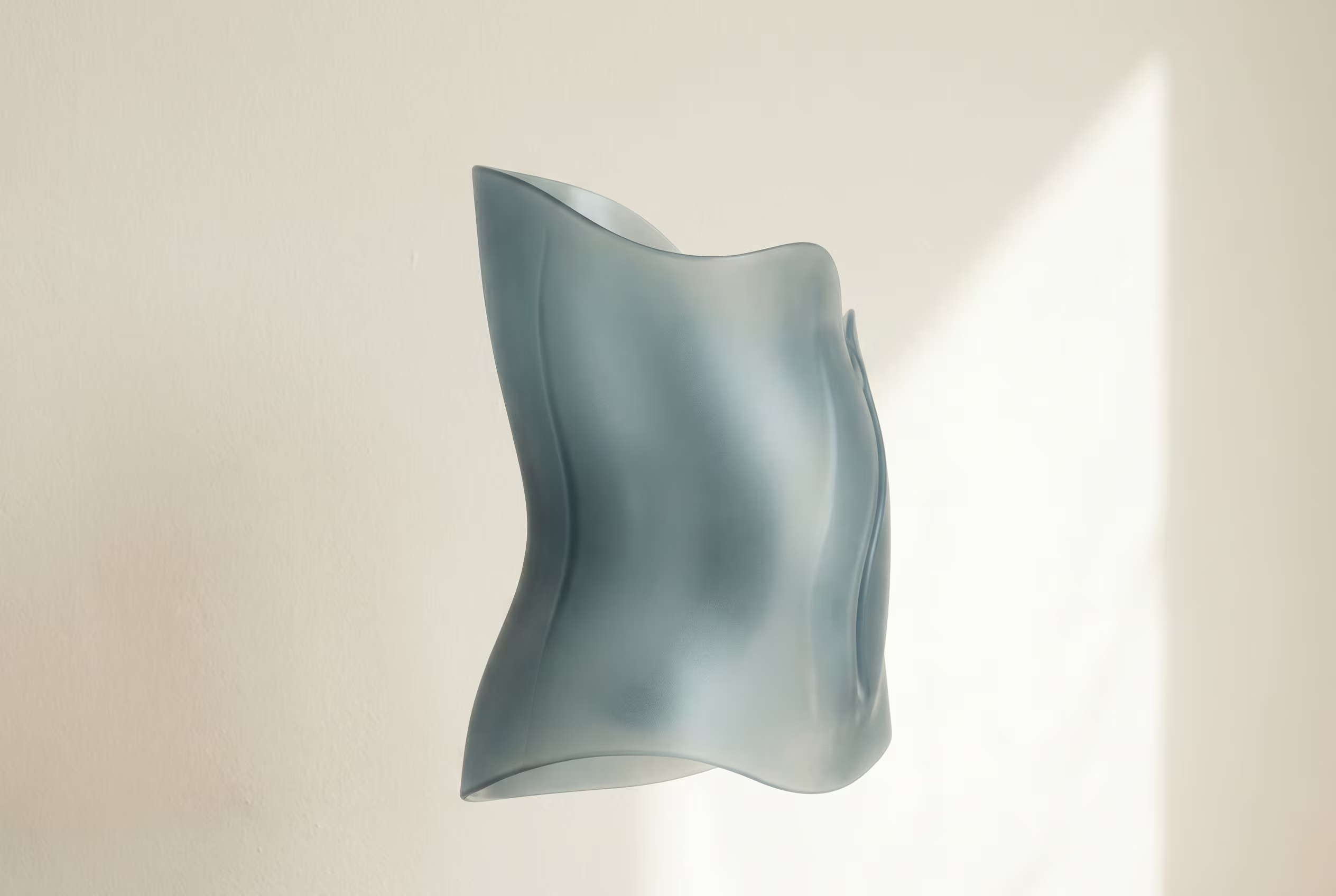
Rigid-frame braces on a Chêneau basis (Chêneau, Chêneau-Gensingen, Rigo-Chêneau) are the standard. Quality grid: precisely fitted CAD/CAM or plaster-based manufacture at an experienced orthotic workshop; a documented in-brace primary correction of ≥40% on the first cast; in-brace X-ray as a check; regular refits during growth; and close exchange between doctor, therapist, and orthotist. A poorly fitting brace is worse than useless — it creates false security without the biomechanical effect.

A modern Chêneau-style brace, designed to disappear under clothing

Wear time and everyday life

20–23 hours of wear per day is the guideline-close recommendation. That includes night and school. The brace comes off for showering, sport, and short breaks. Sport time counts as wear time. Clothing: seamless cotton directly on the skin under the brace, loose tops over it.

Realistic expectations — what the brace does not do

The brace prevents progression, but it does not fully reverse an existing curve. After weaning, typically a share of the primary correction is retained while some of it is lost again. A corrected curve stays visibly stable, not geometrically perfect.

Check-ups under bracing — how often

Clinical follow-up every 3–6 months. An in-brace X-ray at the start and when meaningful changes occur. Out-of-brace X-rays at defined intervals. Fit is regularly checked and adjusted; strong growth may require a new brace. This is the normal rhythm, not an escalation.

22 hours sounds impossible — a realistic look

Conversations with families show a pattern: the beginning is the hardest part; after a few weeks it becomes easier. What helps: a fixed ritual (for example sleep, school, and free-time blocks), support from family and friends, the therapist as a motivator, structured psychological support where it helps, and realistic interim goals. A brace that is not worn does not work. That is the honest equation, without moralising.

Brace and adolescence — the social side

The brace is visible and changes how the body moves. That is a psychological burden that deserves to be taken seriously. Open handling with classmates, teachers, and coaches usually helps more than keeping it secret. When the burden persists, we offer supportive psychological counselling.

How brace therapy ends — weaning

With growth completion (Risser 4–5, Sanders 7–8, ≥2 years after menarche, stable body height) stepwise weaning begins: first fewer daytime hours, then gradual reduction over several months under medical supervision. The end is confirmed with an X-ray and a clinical check-up.

For teens: directly to you

20 to 23 hours a day sounds brutal. It gets easier — most people say the first few weeks are by far the hardest, then the brace becomes background noise. A couple of honest things. The brace is not a punishment; it is the tool that, if you actually wear it, can keep you off an operating table. Hidden does not usually work as a strategy — telling a few friends, a teacher you trust, and your PE teacher ahead of time saves a lot of awkward moments. Sport is not just allowed; it counts as wear time when you take the brace off for it. If it is cutting into your skin, rubbing, or making you hate your day, say so — the fit gets adjusted. And if the whole thing is weighing on you mentally, there is real psychological support; asking for it is not weakness.

Your Checklist for This Topic

Bracing is indicated at Cobb 25°–<40° with Risser 0–3 or Sanders 3–6. Wear time 20–23 h/day including night, sports time counts as wear time. In-brace primary correction ≥40% on the first fit is a quality marker. Check-ups every 3–6 months. Weaning begins with growth completion (Risser 4–5, Sanders 7–8, ≥2 y post-menarche, stable height). The brace prevents progression — it does not fully reverse the curve.

A brace is not a punishment — it is an investment. Consistent wear for 2–3 years can save your child from a major surgery. The adjustment period is real, but most teenagers adapt faster than parents expect. Focus on practical solutions: the right clothing, school communication, skin routine, and emotional support.

  1. Is my child a good candidate for bracing (age, growth, curve size)?
  2. What type of brace do you recommend and why?
  3. How do we check if the brace fits correctly (in-brace X-ray)?
  4. How many hours per day should the brace be worn?
  5. When do we expect bracing to end?

Schedule a bracing consultation at our center — we assess whether bracing is right for your child and coordinate with experienced orthopedic technicians.

Book via WhatsApp

Related Guides

Sources & clinical guidelines
  • AWMF-S2kGerman AWMF-S2k Clinical Guideline "Adolescent Idiopathic Scoliosis" (registration no. 151/002), dated 15 March 2023, valid through 14 March 2028. register.awmf.org/de/leitlinien/detail/151-002
  • IQWiGInstitute for Quality and Efficiency in Health Care (IQWiG): information on full-spine X-ray radiation exposure and low-dose protocols.

02 / CONTACT

Book Your Appointment

Message us on your preferred channel. Tell us about your child — we will get back to you with next steps.