Skip to content
Guide 074–5 min read

Scoliosis physiotherapy: what it can achieve, and what it cannot

Scoliosis-specific physiotherapy is a firm building block of every treatment plan. For mild curves it is applied on its own; for moderate curves it is combined with a brace. It works only when performed consistently and with correct technique.

What makes Schroth physiotherapy different?

Classical physiotherapy strengthens generally. Scoliosis-specific concepts such as Schroth work deliberately with self-correction of the curve, active rotation, directed breathing into the concave side, improved body awareness, and automation in everyday life. The difference is not a matter of intensity but of specificity: every exercise is tuned to the individual three-dimensional curve pattern rather than to a generic "back-strengthening" program.


SEAS and other methods

SEAS (Scientific Exercise Approach to Scoliosis), Dobomed, and BSPTS are all established scoliosis-specific concepts. The differences lie in the procedure, not the goal. What matters in practice is the therapist's training in one of these concepts and the fit of the chosen method to the individual curve pattern — not the brand name on the clinic door.

Schroth-method stretching — asymmetric work for an asymmetric curve

How a therapy session is structured

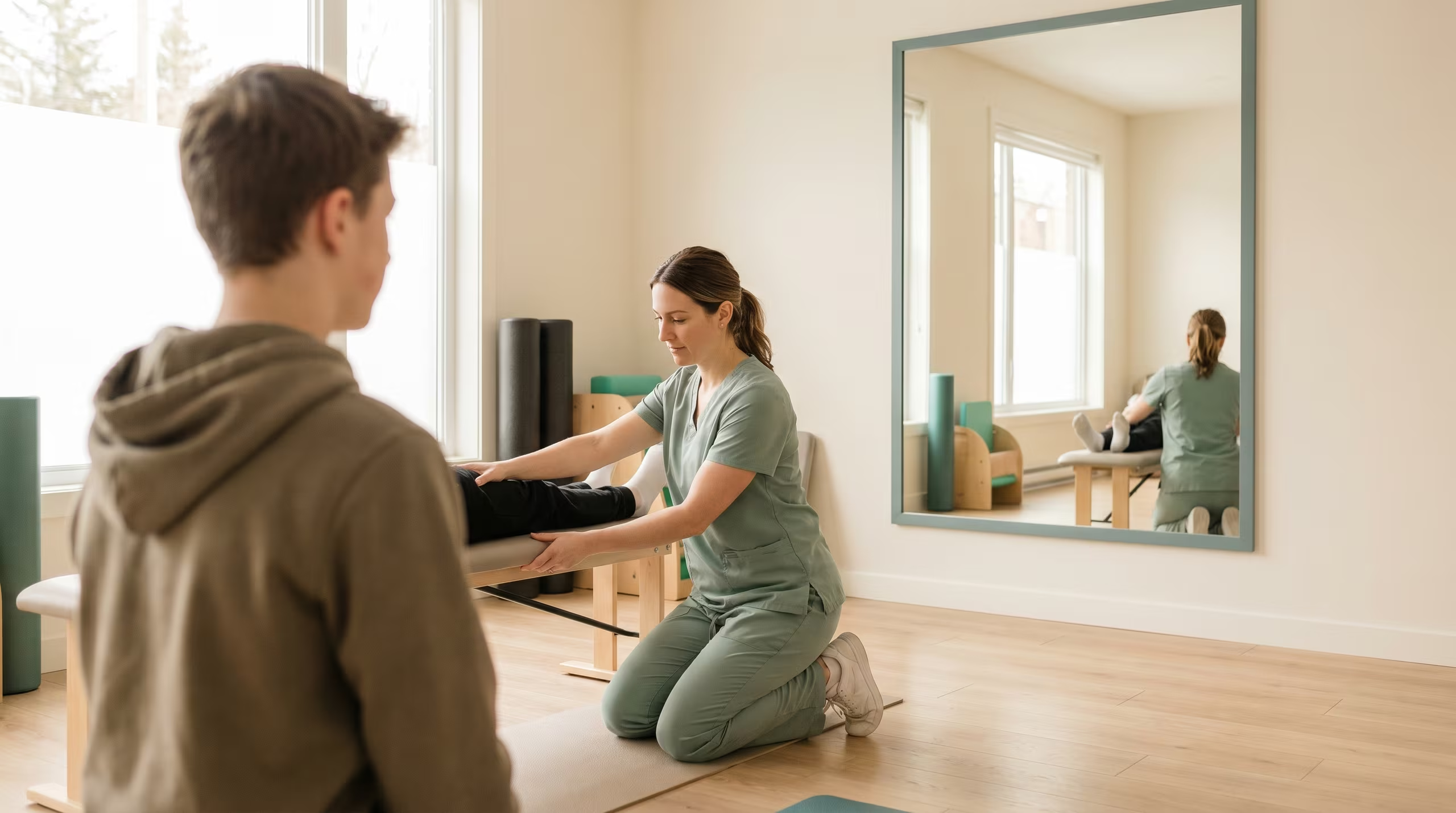
A typical session lasts 45–60 minutes and follows a consistent structure: anamnesis and an entry analysis in standing and forward-bending; perception and breathing exercises; active correction exercises in sitting, standing, and lying positions; strengthening work in the corrected position (not in the default asymmetric one); and a home-program handoff for practice at home between sessions.

How much practice is necessary?

At the beginning of treatment, the typical rhythm is physiotherapy 1–2 times per week plus a short daily home program (10–20 minutes). Later the therapy frequency is reduced, but the home program continues — automation into everyday life is the goal. When a brace is in use, exercises are practised both with the brace on and with the brace off, so that the body learns correction in both states.

How to find a suitable therapist — a quality checklist

Checklist: (1) certified training in a scoliosis-specific concept; (2) experience working with children and adolescents; (3) a fixed primary therapist your child actually works with; (4) willingness to exchange information with the treating medical practice and, where relevant, the orthotic workshop; (5) regular in-session checks of exercise quality; (6) written documentation of progress over time. Where needed, we refer on to suitable practices.

Important to know

Honest boundary — what physiotherapy does not deliver

Physiotherapy does not automatically prevent a curve from increasing; it does not replace a brace when one is indicated; and it does not undo an existing Cobb-angle curve. What it does improve is mobility, strength, body awareness, and everyday functioning. Set correctly, physiotherapy is a valuable complement to guideline-based treatment, not a substitute for it.

Exercises on your own — YouTube and similar

General trunk-strengthening at home, yes. Specific "scoliosis exercises" from the internet, no. Incorrectly performed exercises can reinforce the existing asymmetry instead of correcting it. A short, clean instruction from a qualified therapist — even a recorded reference video of your own exercises on a phone — is more useful than a YouTube video made for a generic audience.

For teens: directly to you

Be honest: this only works if you do it. A few minutes most days beats an hour once a week. You don't need to feel exercises hurting to know they're working — the point is accuracy, not effort. Breathing exercises look easy but they're the point: you're re-teaching your ribs how to move. Skip YouTube "scoliosis cures" — generic spine workouts can reinforce your asymmetry. Ask your therapist to record one clean video of your core exercises on your phone so you have a reference when you practise alone. And: progress here isn't measured in "how much my curve shrunk." It's measured in "I can tell when I'm slouching, I breathe better, my back bothers me less."

Your Checklist for This Topic

Scoliosis-specific physio (Schroth, SEAS) is tailored to the curve pattern — not generic exercises. It improves posture, breathing, pain, and quality of life. It does not significantly correct Cobb angles alone. Best results as complement to bracing. Find a certified scoliosis physiotherapist.

Exercises are a valuable tool in your child's scoliosis toolkit — but they are one tool, not the whole toolkit. If your child needs a brace, exercises complement it. If the curve is mild and just being monitored, exercises can improve body awareness and prevent deconditioning. Ask your doctor what role physiotherapy should play at your child's current stage.

  1. Should my child start scoliosis-specific physiotherapy now?
  2. Which method (Schroth, SEAS) do you recommend for this curve pattern?
  3. Can you recommend a certified scoliosis physiotherapist?
  4. How often should the exercises be done?
  5. Should exercises continue during brace treatment?

Ask your doctor about the right physiotherapy plan for your child's curve and treatment stage.

Book via WhatsApp

Related Guides

Sources & clinical guidelines
  • AWMF-S2kGerman AWMF-S2k Clinical Guideline "Adolescent Idiopathic Scoliosis" (registration no. 151/002), dated 15 March 2023, valid through 14 March 2028. register.awmf.org/de/leitlinien/detail/151-002
  • IQWiGInstitute for Quality and Efficiency in Health Care (IQWiG): information on full-spine X-ray radiation exposure and low-dose protocols.

02 / CONTACT

Book Your Appointment

Message us on your preferred channel. Tell us about your child — we will get back to you with next steps.