Skip to content
Guide 055–6 min read

How scoliosis develops during growth

The course of adolescent scoliosis is determined primarily by the remaining growth potential and the current Cobb angle. Both parameters are measurable, and they form the basis of every well-grounded decision.

When does the spine grow, and how much?

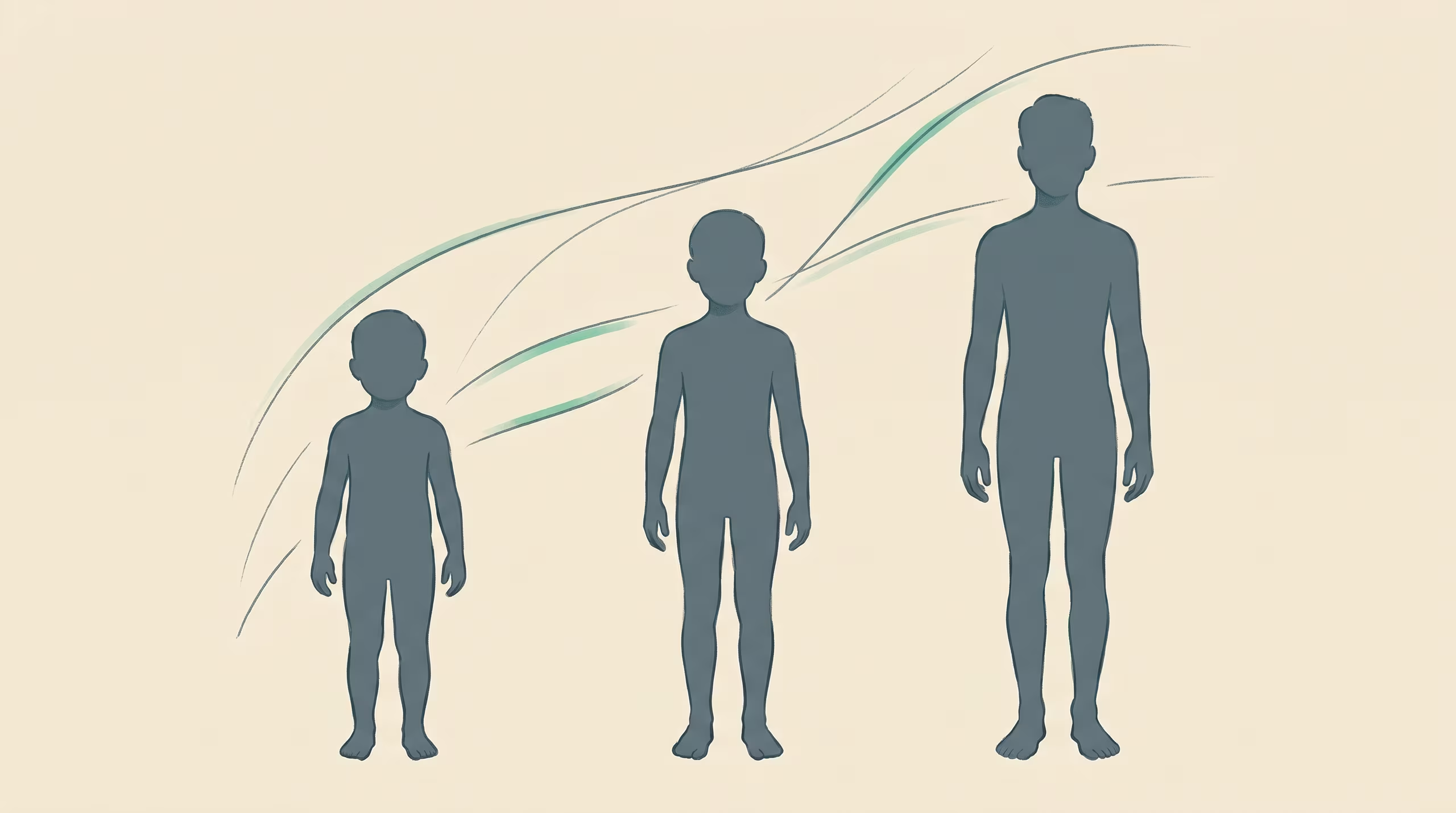
The connection between puberty, the growth spurt, and progression risk runs as follows. In girls: the main risk window is 10–14 years, around and before menarche; progression risk drops clearly 1.5–2 years after menarche, because that marks the deceleration of linear growth. In boys: the main risk window is 12–16 years, and the risk window typically ends later than in girls because male skeletal growth completes later. This is also why growth tracking — current height both sitting and standing, growth velocity between visits, and the date of menarche in girls — is recorded at every visit: two children of the same age and the same Cobb angle can have very different risks depending on where they sit in this window.
Risser, Sanders and menarche — what they tell us

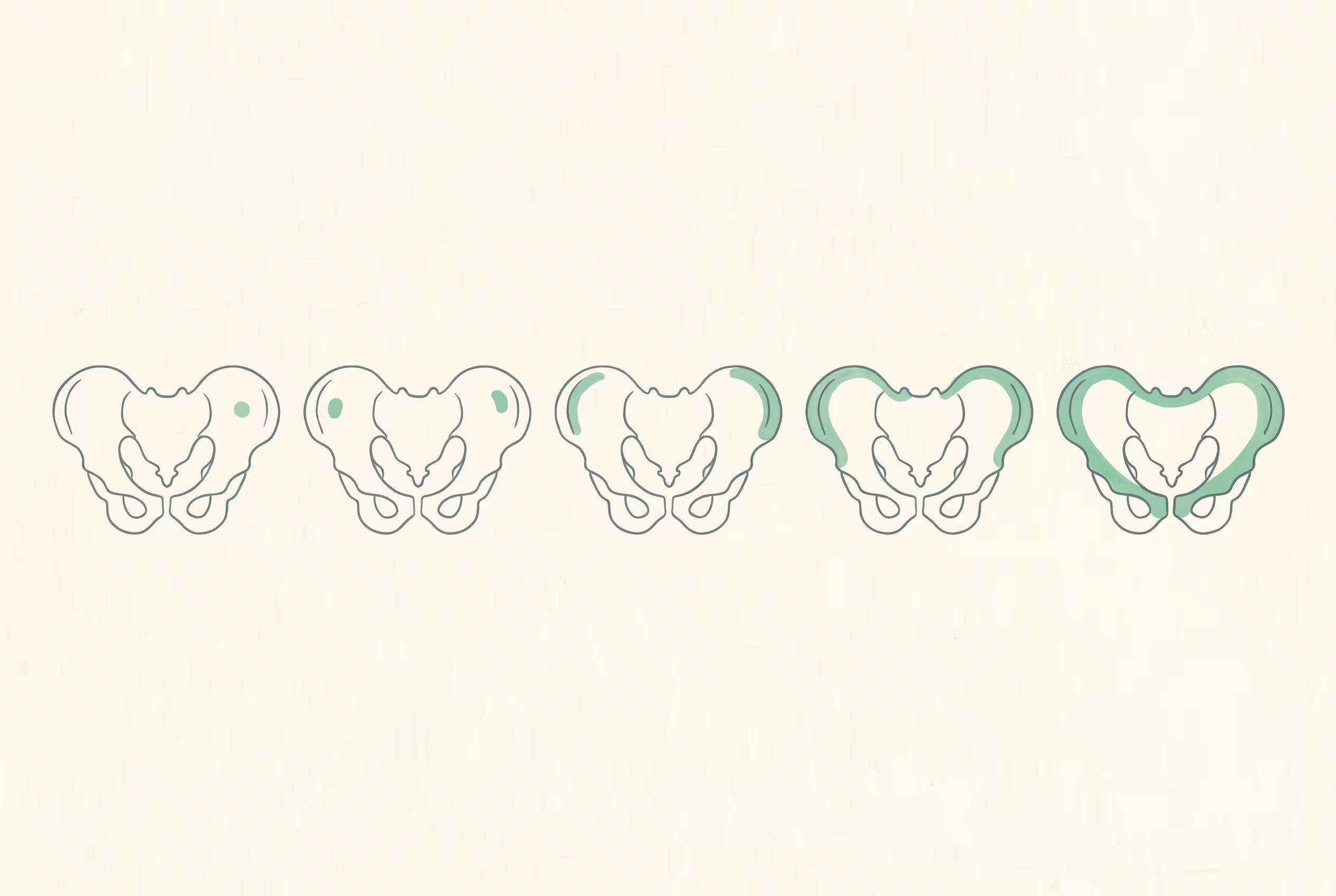
Infobox on Risser — the 0–5 grade of iliac apophysis ossification on the standing full-spine X-ray: Risser 0 — no ossification at the iliac crest yet, highest remaining growth; Risser 1–3 — actively in the growth spurt; Risser 4 — little remaining growth; Risser 5 — growth largely complete. Infobox on Sanders — the 1–8 grade of digital-skeletal-age maturity on the left-hand X-ray, with finer resolution than Risser in early puberty: Sanders 1–3 — pre-growth-spurt phase; Sanders 4 — peak, highest progression risk; Sanders 5–6 — growth velocity decreasing; Sanders 7–8 — growth largely complete. The menarche interval in girls complements these: up to about 1.5–2 years post-menarche, significant linear growth may still occur; after that window the residual growth is small.

Risser stages 0–5 — bone-age markers that predict remaining growth

How large is the risk that the curve increases?

Risk is stratified by the combination of Cobb angle × maturity marker × sex. Rough orientation: a 20–29° curve at Risser 0–1 has approximately 70% progression risk; the same curve at Risser 2–4 has approximately 25%; pre-menarcheal girls are at about 4× the risk of post-menarcheal girls at the same Cobb; double-major curves progress more than single curves; thoracic curves more than lumbar. These numbers are reference values from natural-history studies (Lonstein-Carlson and successors), not individual prognoses. The personal course curve — 2–3 consecutive measurements in comparable conditions — is the strongest real-world indicator of how this particular child is tracking.

When is a course considered stable?

Stability is a pattern over time, not a single moment. A course is considered stable when two to three consecutive check-ups show no relevant increase (each change under 5° and within measurement error), skeletal maturity is clinically confirmed, mobility is unremarkable, and there are no new symptoms. From that point the check-up rhythm lengthens — typically once a year, and for long-term follow-up usually every one to two years.

What happens after growth is complete?

Mild curves usually stay stable. Medium and large curves can continue to progress slowly in adulthood, typically on the order of a few degrees per decade; long-term natural-history data (Weinstein's 50-year Iowa cohort and follow-ups) show that curves above ~50° at skeletal maturity tend to drift by roughly 1° per year. Complaints are not mandatory and do not correlate with the Cobb angle alone; trunk balance, muscular fitness, and back-pain history matter at least as much. Movement, strength, and trunk stability stay important across the whole life.

Important to know

When an earlier check-up makes sense

Do not wait for the next scheduled visit if any of the following appear: the asymmetry is visibly increasing; there is a clear height jump in a short time; breathing feels noticeably restricted with very large curves; or new neurological symptoms appear (numbness, weakness, gait disturbance, bladder or bowel problems). These findings need prompt assessment — they are exactly the situations the regular control schedule is designed to catch earlier, not later.

For teens: directly to you

"Progression" is a word doctors use for "it got bigger." It's not a grade on you. Most of the time the curve either stays stable or changes very slowly, which is why you're being checked at all — to notice real change early, not to react to every small wobble on the X-ray. Growth is the real driver: while your body is in the pubertal spurt, there's more room for the curve to move. Once growth finishes, for most people things settle. Keep moving. Sport is fine, usually encouraged. Check-up visits aren't a big deal — a clinical exam, sometimes a scoliometer, sometimes an X-ray if there's a real reason.

Your Checklist for This Topic

Progression risk depends on curve size + remaining growth. The pubertal growth spurt is the highest-risk window. Risser sign (0–5) and Sanders stage (1–8) estimate growth remaining. Curves under 30° usually stabilize after growth. Curves above 50° may progress ~1°/year even in adulthood. Check-ups every 4–6 months during growth.

Your child's curve is not a fixed sentence. Growth stage is the single biggest predictor of what happens next. If your child is still growing, monitoring is critical — not because something bad will definitely happen, but because catching progression early gives you the most treatment options. If growth is nearly complete and the curve is moderate, the outlook is usually reassuring.

  1. How much growth does my child have remaining (Risser/Sanders)?
  2. Is the curve stable or has it been progressing?
  3. What is the risk of further progression in my child's specific case?
  4. How often should we schedule check-ups at this stage?
  5. At what point would treatment need to change?

Schedule a follow-up at our center — we assess growth stage, curve behavior, and give you a clear prognosis for your child's specific situation.

Book via WhatsApp

Related Guides

Sources & clinical guidelines
  • AWMF-S2kGerman AWMF-S2k Clinical Guideline "Adolescent Idiopathic Scoliosis" (registration no. 151/002), dated 15 March 2023, valid through 14 March 2028. register.awmf.org/de/leitlinien/detail/151-002
  • IQWiGInstitute for Quality and Efficiency in Health Care (IQWiG): information on full-spine X-ray radiation exposure and low-dose protocols.

02 / CONTACT

Book Your Appointment

Message us on your preferred channel. Tell us about your child — we will get back to you with next steps.